Forward Deployed Architect & Forward Deployed Engineer

Quantified business and delivery friction in a single discovery sprint

LEIT DATA Forward Deployed Architect (FDA) and Forward Deployed Engineer (FDE) offering helps organisations uncover the business and delivery friction that slows transformation programmes before it becomes expensive or difficult to reverse. Designed for CIOs, CDOs, and transformation sponsors, the service combines stakeholder interviews, process review, collaborative workshops, and system evidence to identify where delays, inefficiencies, and route-to-live risks are building up across programmes such as ERP, AI/ML, modern data platforms, and regulatory change.

What makes this approach different is that it looks at both sides of the problem at the same time. The FDA focuses on business friction such as process inefficiencies, data quality issues, master data gaps, governance blockers, and reporting delays, while the FDE examines delivery friction including release bottlenecks, fragile pipelines, environment delays, observability gaps, and cost waste. These issues are then quantified using a simple model based on hours, cost, and frequency, giving leadership a clear evidence base for prioritisation and decision-making.

Forward Deployed Architect and Engineer discovery illustration
Forward Deployed discovery sprint illustration
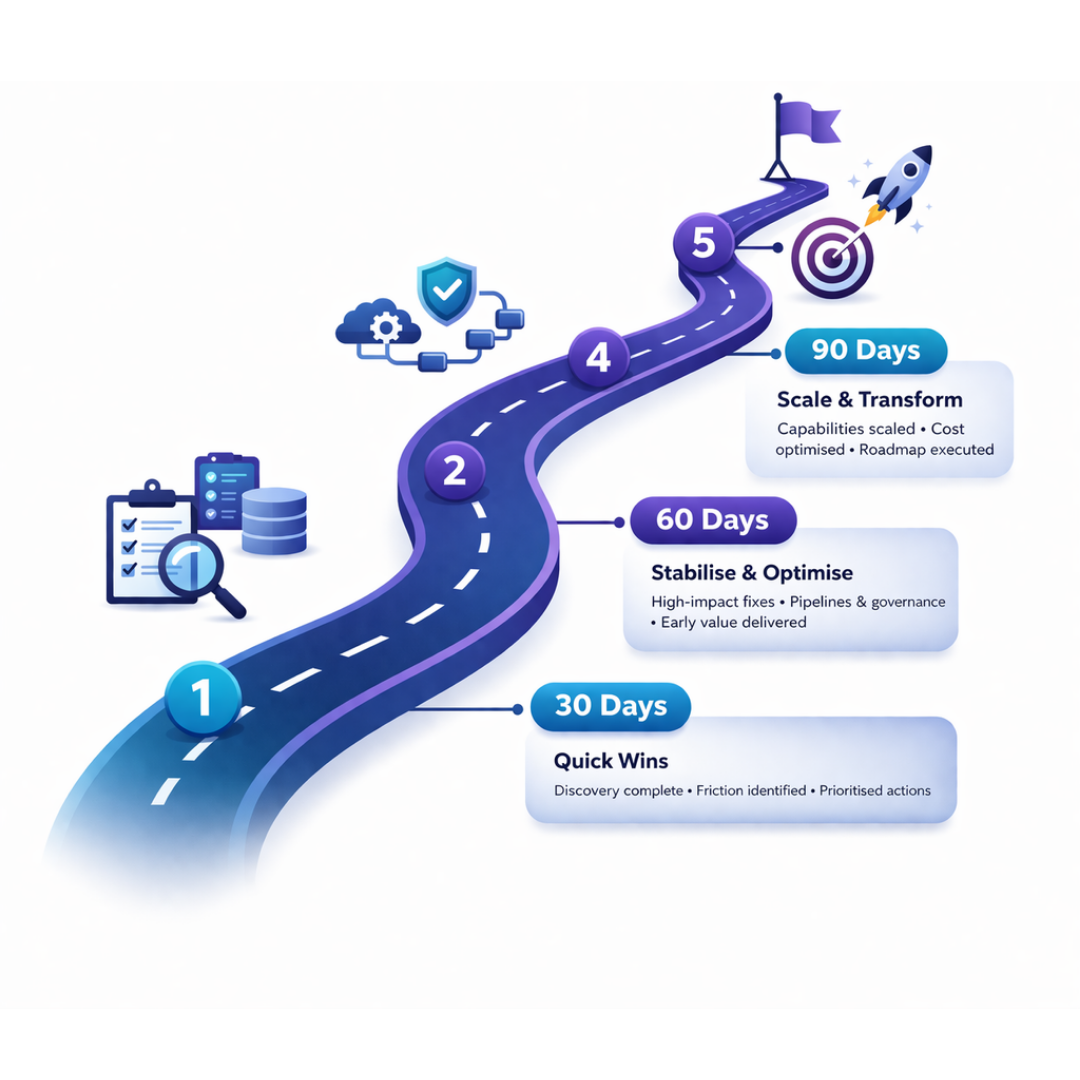
The outcome is a practical, decision-ready roadmap rather than a high-level diagnostic. Each discovery sprint produces a quantified friction inventory, a current-state assessment, stakeholder insight, and a prioritised set of actions mapped to LEIT capabilities such as Tagging and Metadata, Security and Compliance, DataOps / CI-CD, FinOps and Cost Optimisation, and Transformation. The result is faster executive alignment, clearer ownership, and greater confidence to move from discovery into delivery with a structured plan for the next 30, 60, and 90 days.

How We Work

Evidence-backed delivery from discovery to managed run-state.

Evidence over opinion

Recommendations tied to stakeholder insight, process review, and operational evidence.

Friction before funding

We quantify business and delivery friction (hours x cost x frequency) before transformation spend is locked in.

Governed by design

Human approval gates, audit trails, and compliance mapping, not ad-hoc AI or workshop theatre.

Route-to-live focus

From discovery through DataOps, security, FinOps, and managed run-state.

How we identify and prioritise friction

We look at friction through three lenses, then carry each point through a consistent path so every recommendation is traceable from a real, observed friction point to a capability and a place on the roadmap.

Business friction

Where processes, reporting, or decisions are slowed or constrained by data and platform limitations.

Delivery friction

Where technical, process, or organisational factors slow engineering and delivery.

Operating-model friction

Where ownership, access, lineage, and governance gaps create rework or risk.

  1. Identify the friction from stakeholder sessions and source evidence.
  2. Quantify the time, spend, and risk it carries today, in business terms.
  3. Map it to the value levers it affects: revenue, cost, risk, speed, and capability.
  4. Route it to the platform capability that addresses it.
  5. Prioritise by friction magnitude, business impact, force-multiplier potential, and effort.
  6. Translate it into the friction-to-capability map and prioritised roadmap.

What to expect

Weeks, not monthsParallel FDA + FDE tracksSteering-committee-ready roadmap

Snowflake Service Partner Elite · 2025 Cortex Integration · 2026 Intelligence Launch